A Winter Visit to the Purple House Near Hannibal And the Strange Magic Hidden Inside
There are houses that politely exist, blending into their neighborhoods with modest charm. And then there are houses that stand with such unapologetic character that you feel them before you even understand them. The tall purple house near Hannibal’s Historic Downtown District belongs decisively to the second category. The first moment I saw it, standing…
There are houses that politely exist, blending into their neighborhoods with modest charm. And then there are houses that stand with such unapologetic character that you feel them before you even understand them.
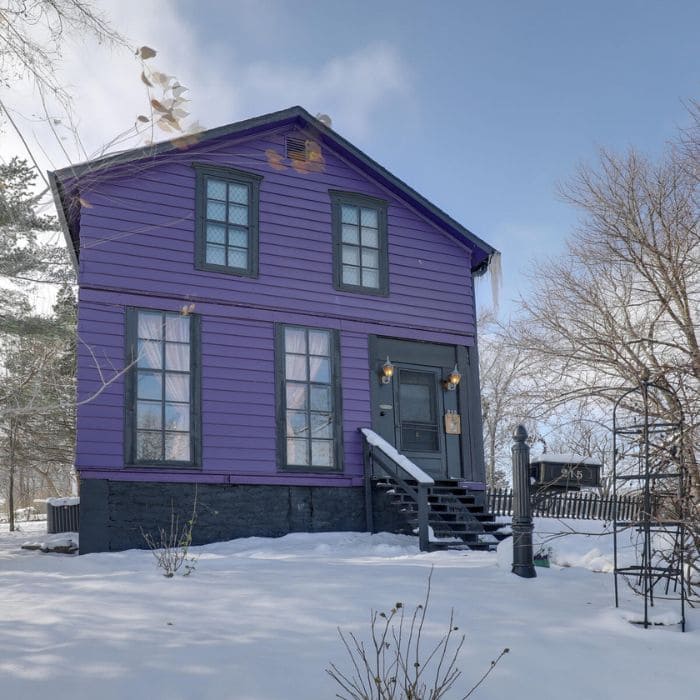
The tall purple house near Hannibal’s Historic Downtown District belongs decisively to the second category. The first moment I saw it, standing alone against a bright sweep of winter snow, I felt as if the season itself had paused to watch over it.
Fresh snow muffled every sound except the soft crunch under my boots as I walked closer. The deep violet siding of the house rose boldly from the white landscape, and the dark window trim made each window look like an old portrait frame left out in the cold.
Icicles hung from the roofline like pieces of crystal glass, catching the pale sun and making the home glow in a way that felt equal parts mysterious and inviting.
Something about seeing such dramatic color in the dead of winter stirred my imagination even before I stepped inside.
It looked theatrical and slightly mischievous, the sort of place where stories sleep in the walls and only wake when you enter.
The Entry Hall: A Staircase Wrapped in Reflections
The transition from snowy quiet to the entrance hall felt like stepping into a completely different reality. The temperature warmed, the scent of aged wood floated up from the floors, and the house revealed its personality all at once.
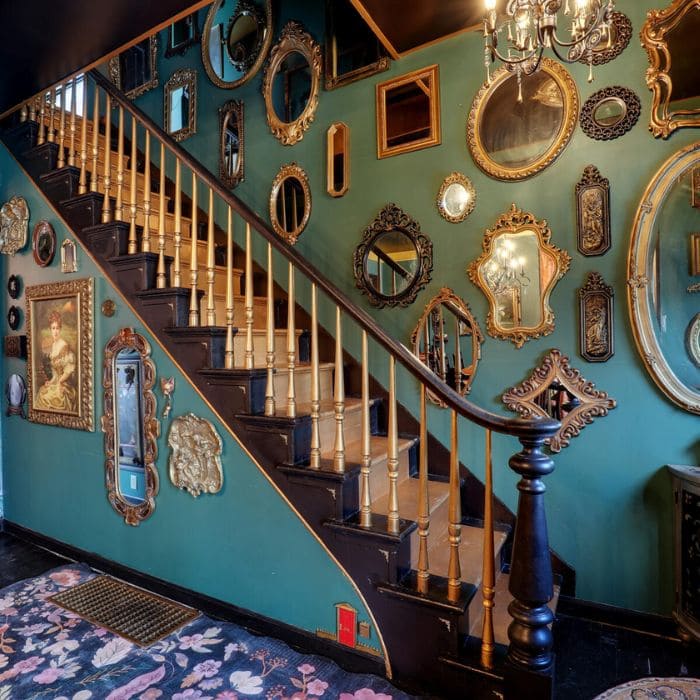
The staircase immediately became the centerpiece, its platform, railings, and deep wooden steps glowing under chandelier light. But what truly stopped me was the wall beside it.
Layer after layer of ornate mirrors covered the stair wall from the baseboards almost to the ceiling. Every style imaginable had a place here: gilded Victorian frames with curling leaves, oval mirrors reminiscent of old dressing salons, and tiny decorative pieces that looked plucked from European flea markets.
Each mirror reflected something different with the chandelier, my scarf, the staircase curve, the winter light from the doorway and suddenly the hallway felt alive, breathing with a thousand soft glimmers.
Instead of overwhelming me, the mirrors created a strangely soothing sense of continuity. It felt as though the house had been collecting these reflections for decades, saving pieces of every visitor as if memories themselves were decor.
Walking up that staircase, surrounded by those mirrors, felt like climbing through the house’s own scrapbook.
The Dining Room: A Jewel Box of Color and Drama
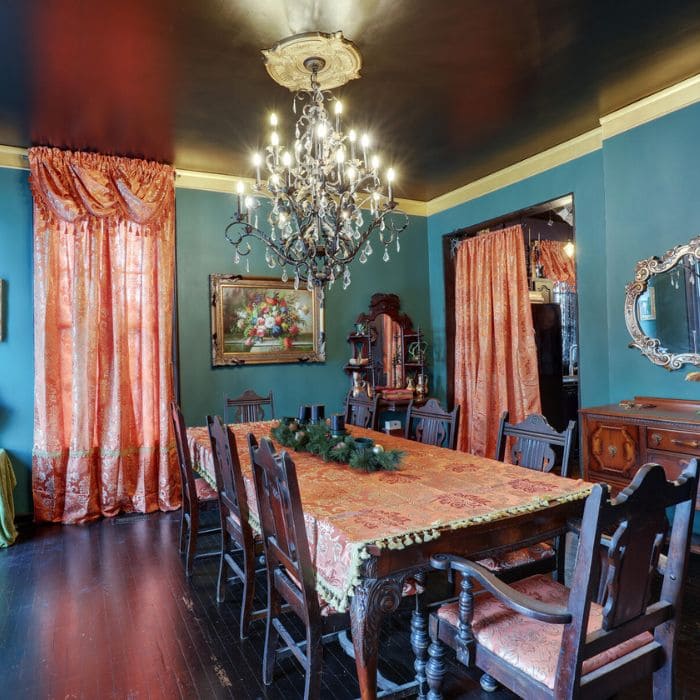
If the entry hall was a gallery of reflections, the dining room was a jewebox. The walls were a deep teal that shifted its tone depending on where the chandelier light touched it.
In contrast, heavy brocade curtains in an opulent orange-gold shimmered with their own quiet richness, pooling in soft folds along the dark floors.
The long wooden dining table sat proudly in the center of the space, draped in fabric that echoed the curtains’ patterns but with an aged softness that only time can produce.
Along the room’s edges, antique sideboards and carved wooden chairs stood like actors waiting for their cue. A grand mirror, framed with detailed scrollwork, stretched across the wall and reflected the chandelier’s branches of crystals, multiplying the glow into a warm and intimate halo.
The room felt like it belonged to another century, a place where dinners lingered late into the night, where stories were exchanged slowly, and where candlelight added its own commentary on every conversation.
Even with the house empty, I could almost hear the echoes of its gatherings.
The Velvet Parlor: A Room That Loves Its Own Shadows
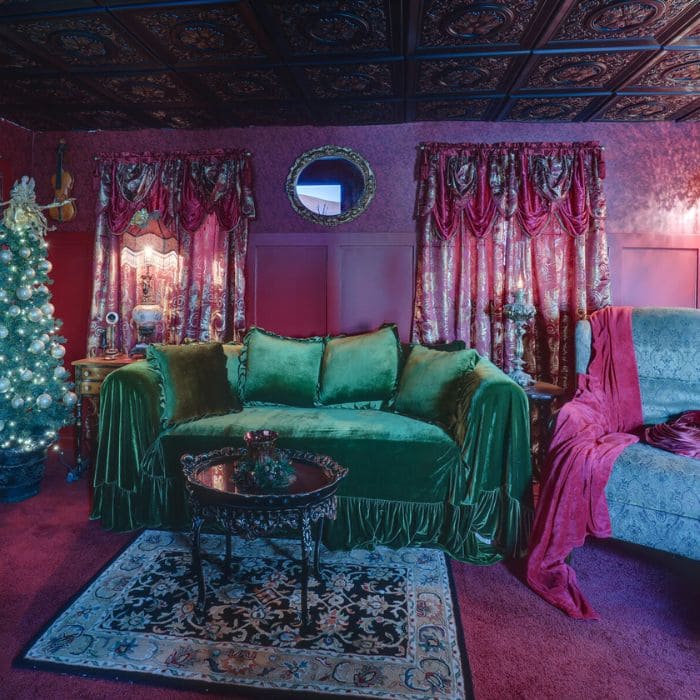
Turning into the parlor, I felt as though I had wandered into a space that had been designed for storytelling. The walls were wrapped in deep red damask patterns, the type of texture that absorbs light instead of reflecting it.
Paired with heavy ruby drapes gathered dramatically around the windows, the whole room seemed built to cradle shadows in an affectionate way.
At the center of this ambiance stood a green velvet sofa, its color so vibrant it seemed to hold its own internal light. Christmas décor sparkled quietly beside it, a small, decorated tree, a few delicate lamps, giving the room a warm, nostalgic glow.
The ceiling, covered in intricately pressed tin tiles in dark bronze, completed the feeling that the room belonged to a timeless world where evenings were spent not in front of screens but with books, whispered conversations, and soft music.
There was something almost theatrical about the space, but in a comforting way. It felt like a room that welcomed both dramatic personalities and gentle souls, giving each one a cozy place to rest.
The Black Bedroom: A Gothic Opera of Texture and Light
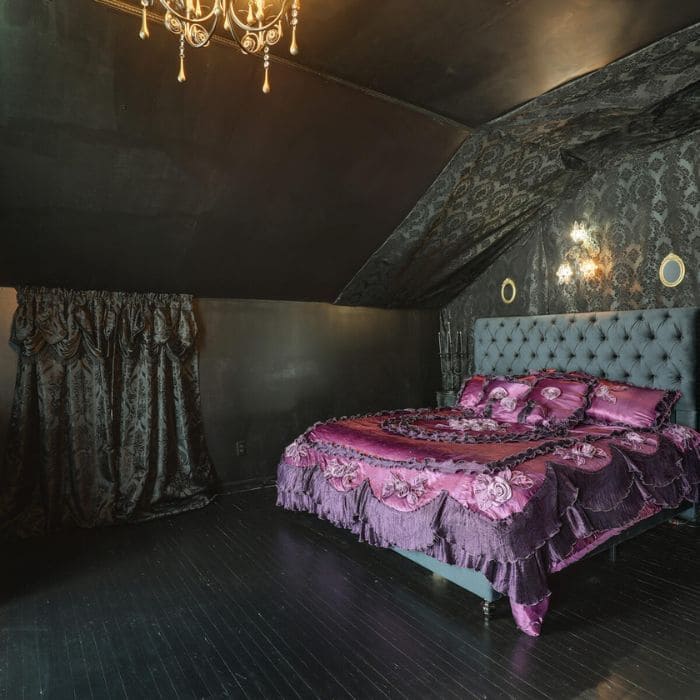
Upstairs, the bedroom was perhaps the most astonishing space in the entire house.
Painted in a rich, satin-black shade, the slanted ceilings and walls created a cocoon-like atmosphere that made everything inside feel intensified. Yet, instead of feeling heavy, the room felt intentional, like every surface wanted to show off its texture.
The wallpaper shimmered with a raised damask pattern that softened the darkness, and the tufted headboard in deep charcoal blue elevated the bed into a statement piece.
The bedding itself was a masterpiece of layered purples, ruffles, and rose appliqués, transforming the bed into something reminiscent of a dramatic costume from a grand opera.
Simple, vintage lighting illuminated only what the room wanted you to see, a soft silhouette of a candelabra, the metallic sheen of a decorative mirror, the folds of the draped curtains. Every corner felt thoughtfully shadowed, leaving the imagination to fill in the rest.
It was the kind of bedroom that might inspire dramatic dreams or quiet, meditative nights, depending on who slept there.
The Bathroom: Old-World Patterns Meets Soft Glamour
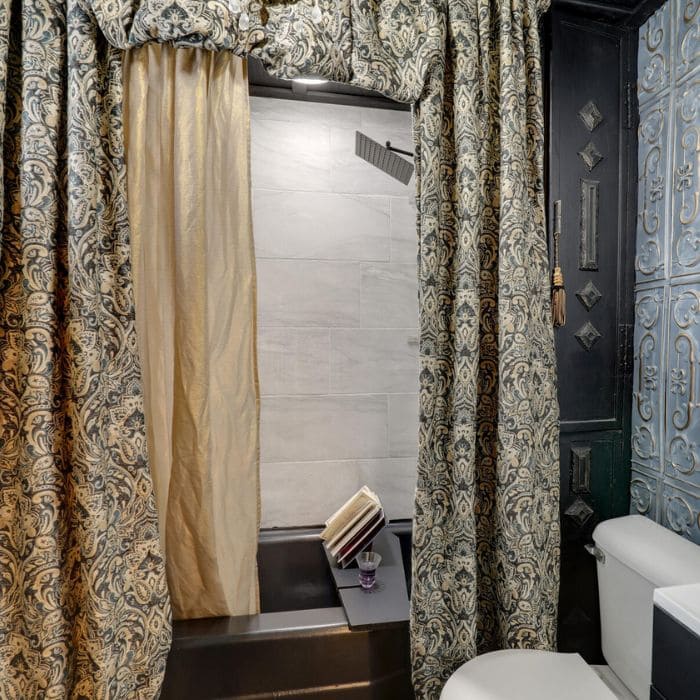
Even the smallest spaces continued the home’s dedication to ornate, emotive design.
The bathroom offered a surprising blend of patterns and decadence, thick paisley curtains formed a layered, theatrical entrance to the shower, and the walls displayed embossed panels in shades of blue-gray with golden detailing.
The soft lighting and richly patterned textiles created a warm cocoon that felt far removed from modern minimalism. This bathroom didn’t try to be sleek; it tried to be memorable. And it succeeded.
Winter Outside, Warm Wonder Inside
What made exploring this house unforgettable wasn’t just the contrast between its dramatic interiors and the quiet winter world beyond the windows.
It was the realization that this home follows a style rarely seen today, a blend of Victorian Gothic Revival and romantic old-world maximalism, infused with the personal theatricality of someone who loves storytelling through color, texture, and ornament.
Victorian Gothic homes were famous for embracing bold statements: deep jewel tones, heavy drapery, ornate woods, and rooms that felt layered with meaning.
From the outside, its purple siding and black trim might feel surprising, yet in winter the combination makes perfect sense. The snow softens the landscape, allowing the home’s colors to stand out like a fairytale illustration.
It would suit someone who finds comfort in rich atmospheres, someone who loves literature and old films, someone who enjoys the romance of dim lighting and shadowed corners.
It’s a house for people who collect memories in the form of objects. People who are happiest in spaces that feel layered, emotional, and slightly mysterious.