Our Visit to a 500-Year-Old Savannah Farmhouse
Last month, on a quiet Saturday morning, Dan and I were sorting small projects around the house when my phone started ringing. I didn’t recognize the number at first, but the moment I heard the voice on the other end, everything clicked. It was Kenny, a member of the old house renovation group we joined…
Last month, on a quiet Saturday morning, Dan and I were sorting small projects around the house when my phone started ringing.
I didn’t recognize the number at first, but the moment I heard the voice on the other end, everything clicked. It was Kenny, a member of the old house renovation group we joined years ago when we were knee-deep in our own fixer-upper.
His voice carried that unmistakable excitement that only comes when someone stumbles across something special. “Dan, you two need to come see this place,” he said. “It’s a five-hundred-year-old farmhouse, and we’re uncovering things I’ve only ever seen in museums.”
Dan looked at me, eyebrows raised, and that was all the convincing either of us needed. We grabbed jackets, topped off our coffee, and hit the road.
The two-hour drive to Savannah felt shorter than usual, maybe because our curiosity stayed wide awake the whole way.
Arriving at a House Older Than Almost Anything We Know
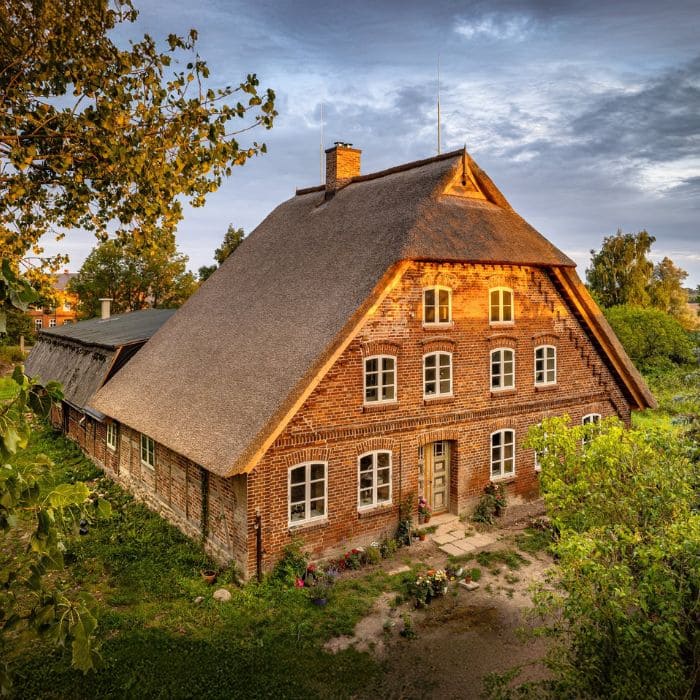
The farmhouse appeared at the end of a dirt lane, wrapped in late-autumn color.
The brick face glowed warmly under the soft Savannah sun, and the steep thatched roof looked almost like a woven blanket pulled tight around the home. The air smelled faintly of earth, hay, and something woody.
Kenny waved us toward the front, and a few familiar faces from our renovation group stepped out to greet us.
These were the people who understood that old houses are never just buildings; they’re time capsules, holding onto every story, every footprint, every forgotten piece.
The Room That Stopped Us in Our Tracks
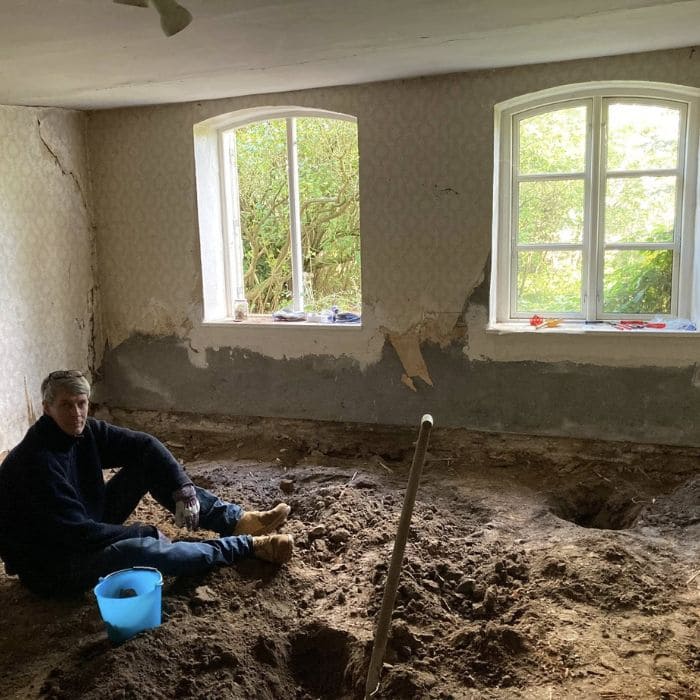
Kenny led us to one of the oldest rooms of the house, a space they had just begun excavating. The moment we stepped in, I understood why he called.
The floor was nothing but dirt, layers and layers of it, recently dug back to reveal enormous foundation stones.
The man sitting on the ground, covered in dust and wearing tired gloves, looked like someone who had been in conversation with the past all morning.
The walls told stories of their own. Wallpaper from the late 1800s peeled off in curled ribbons, and beneath it, faint traces of lime plaster and hand-mixed pigments suggested the house once carried soft blue-green tones typical of Germanic farmhouses built between 1500 and 1700.
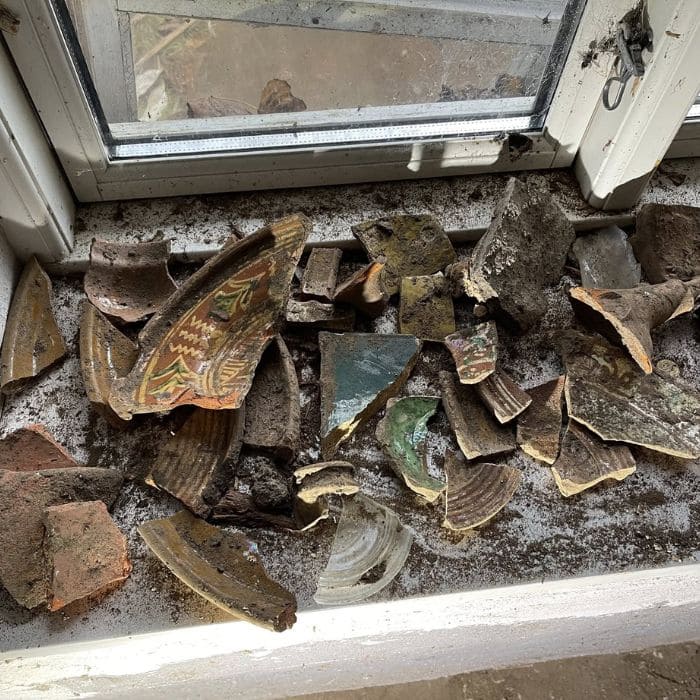
By the window, a pile of fragments lay carefully arranged. They were pieces of slipware pottery decorated with zigzag lines, a pattern common in Central Europe around the 17th century,
One man in this group told us that they are likely to travel by trade routes from the Rhineland. Also, these glass fragments with a slight green showed they were made before industrial glass production took off.
Dan picked up one shard with a chevron pattern still visible in the glaze. Kenny explained that similar pieces had been found on farms in northern Germany and Denmark, often belonging to everyday kitchenware used by the working families who originally lived here.
A Tile With a Face From the Past
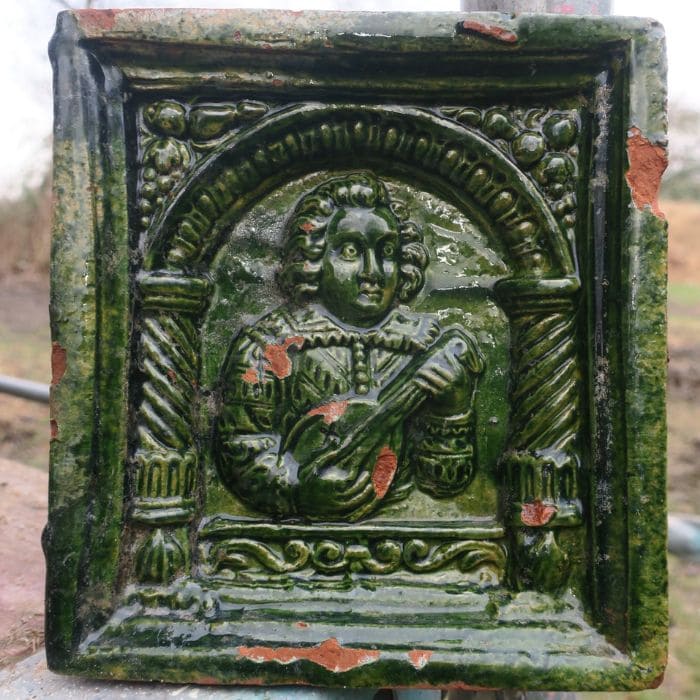
Outside, leaned carefully against a beam, was the artifact that took my breath away, a complete stove tile, glazed in deep forest green.
At first glance it reminded me of something we once saw in an antique shop in Berlin, a similar piece priced around $1,200 due to its rarity. But Kenny explained this one wasn’t bought; it was dug out from right under the farmhouse.
The tile featured a musician dressed in a ruffled collar, holding a lute. The style matched the Baroque period, likely around 1650-1700, when decorative stove tiles were commonly used in large ceramic heating stoves called Kachelofen.
The glossy green glaze was typical of Saxony or Bohemia, regions known for producing tiles with bold colors and fine relief details.
The musician’s face was worn smooth in places, chipped in others, but the craftsmanship still shone through, the curved arches, the rope-twist columns, the clusters of carved berries.
Dan held the tile gently and said, “Someone probably saved every penny to buy a stove decorated like this.” And he was right.
Tiles like these were once considered treasures, handed down through families, sometimes even repaired over generations.
Clues Hidden in the Structure
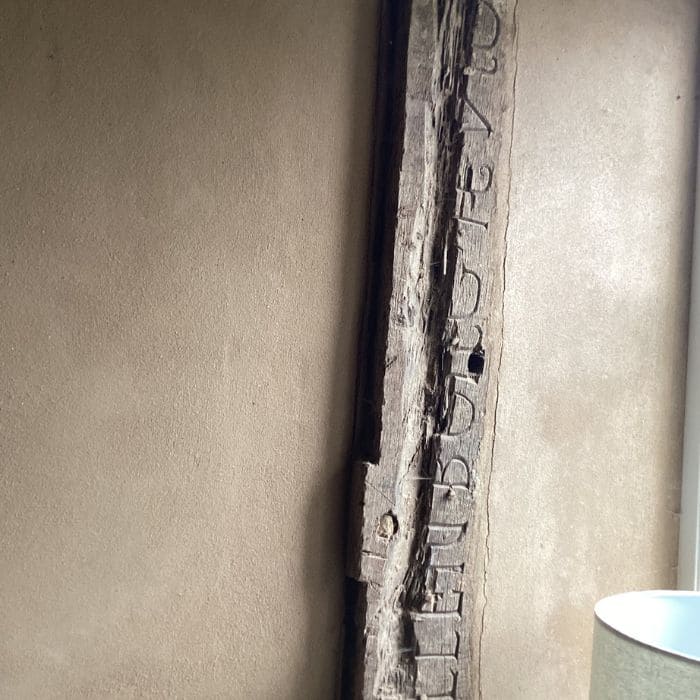
As we walked deeper into the house, Kenny showed us more pieces of history hiding in plain sight.
One wall beam, worn and split from age, carried hand-carved letters and marks, likely initials and dates carved by former owners. Kenny said some of the carvings resembled 17th-century tally marks, which people used to record harvest quantities or building repairs.
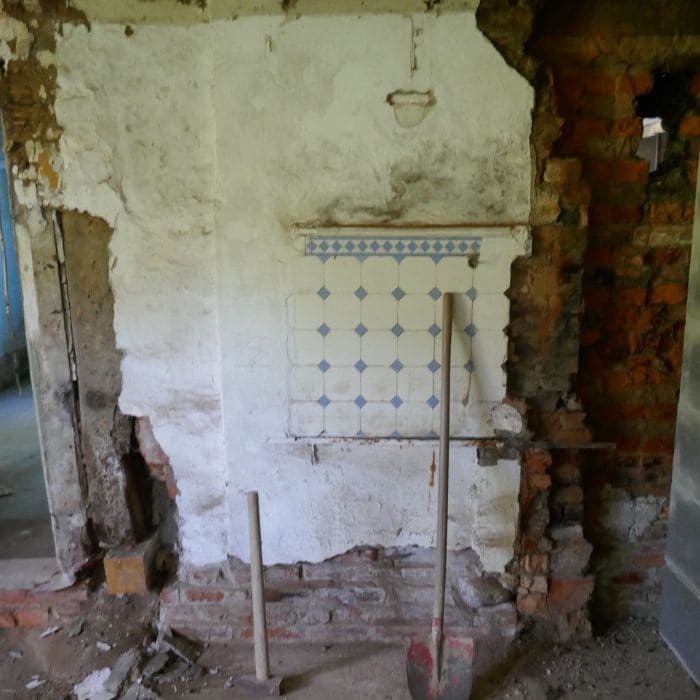
Another room revealed an old tiled stove niche. The tiles, white with faint blue diamonds, looked Dutch in style and probably came from the late 1700s when trade routes between the Netherlands and coastal America were active.
It amazed me that these tiles survived fires, storms, and centuries of human life, still holding their pattern.
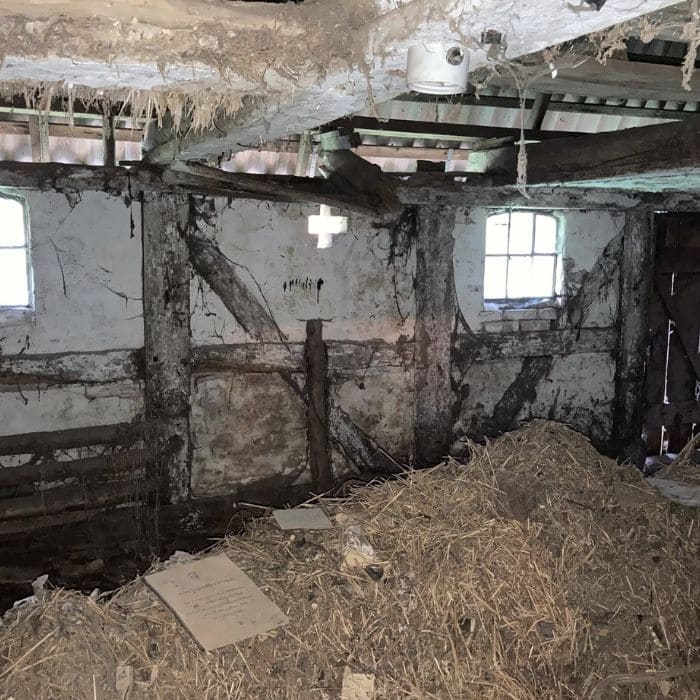
We stepped into what used to be the barn area, where wooden posts darkened with age held up the roof. Straw still covered parts of the floor, along with crumbling pieces of clay and lathe.
The smell was a mix of dust, dried plants, and something earthy that is impossible to recreate unless you are truly standing in a place untouched for hundreds of years.
“Most people would walk out if they saw this,” Kenny laughed. Dan shook his head. “Most people don’t know what they’re looking at.”
Because beneath the decay was evidence of an architectural style rarely found intact – half-timbered construction with wattle-and-daub walls, hand-hewn beams, and stone bases shaped long before modern tools existed.
Driving Back Home
Before we left, Kenny walked us around to the back, where the sun was setting over the fields. The farmhouse glowed, warm and golden, with its brick façade catching the last light of the day.
As we drove back toward Georgia, Dan and I talked the entire trip, letting the weight of the day settle in. We spoke about how rare it is to see a house of this age here, how lucky we were to witness it during a phase when every discovery still felt fresh.
I realized, somewhere between Savannah and home, that days like this are why I love old houses. They remind you that time is not something to fear. It’s something to understand, to preserve, and to appreciate.